
Torrance Divorce Records Lookup
Torrance is part of Los Angeles County and all divorce records from this city are maintained by the Los Angeles County Superior Court system. The county has a courthouse in Torrance and many other locations throughout the county. When you file for divorce in Torrance, your case goes into the Los Angeles County court database. This is the largest court system in California with family law cases going back to 1983 in the online records. Document images are available for cases from May 2000 forward. You can search for divorce cases online using several county portals. The main public access portal lets you search by name or case number for free. Downloading documents costs money. If you need a certified copy of a divorce decree, you can order it online, by mail, or in person at any Los Angeles County courthouse. Certified copies cost $25 when obtained in person.
Los Angeles County Court System
Los Angeles County Superior Court handles all divorce filings for Torrance. The county has a courthouse location in Torrance along with many other courthouses throughout the county. The main family law courthouse is the Stanley Mosk Courthouse at 111 North Hill Street in downtown Los Angeles. The Family Law Clerk's Office is on the fourth floor in Room 426. You can call them at (213) 633-6363. Family Law Files are kept on the first floor in Room 112.
When you file for divorce in Torrance, your case gets entered into the county database. All family law cases are tracked through the same system whether you file in Torrance, downtown Los Angeles, or any other county location. The Archives and Records Center at 222 North Hill Street in Room 212 stores older files. You can reach them at (213) 830-0803.
Los Angeles County has multiple courthouse locations including Long Beach, Pasadena, Norwalk, Lancaster, Pomona, Van Nuys, Torrance, Santa Monica, Compton, and San Fernando. You can file at any of these locations if you meet the residency requirements. Once your case is filed, the records are stored centrally and can be accessed from any courthouse.
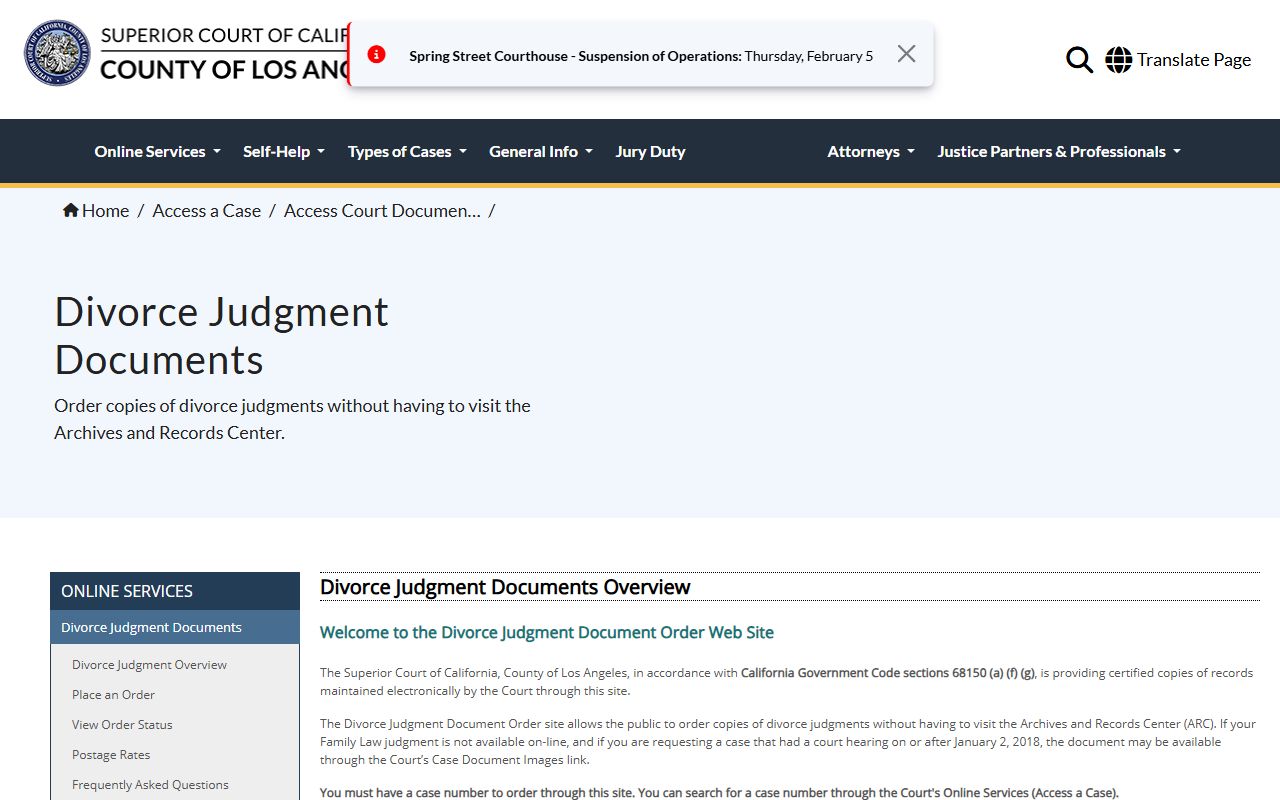
Los Angeles County offers several online tools for searching divorce records. The main public access portal is at lacourt.org/paos/v2public/Login. This system lets you search by party name or case number. There is also a dedicated divorce judgment search at lacourt.org/ldosv2 where you can look up dissolution judgments specifically. LA Court Connect at lacc.lacourt.org provides another way to access case information.
Online Search Process
You can search Los Angeles County divorce records for free. Go to the public access portal and enter a party name. The system will show all matching cases. If you get too many results, add a middle name or filter by case type. Family law cases include dissolution, legal separation, annulment, and domestic violence matters. Click on a case to see the register of actions, which lists every document filed and every court appearance.
Document images are available for cases filed after May 1, 2000. For older cases, you can see the case activity but not the actual documents. To view or download documents, you need to pay. Guest users pay $4.75 per name search. Registered users get the first 10 searches for $1.00 each. Document downloads cost $1.00 per page for the first five pages, then $0.40 per page after that. The maximum charge per document is $40.
If you just need to verify that a divorce happened and when, the free search is enough. You can see the filing date and the judgment date without paying. If you need the actual divorce decree or other documents, you will need to pay the download fees or order copies from the court clerk.
The dedicated divorce judgment portal at lacourt.org/ldosv2 focuses on dissolution cases. This portal is useful if you know you are looking for a divorce and not another type of family law case. You can search by party name and see only dissolution judgments. This can save time if you are specifically looking for divorce records.
Getting Certified Copies
A certified copy of a divorce decree has a court seal and signature. This is the official version you need for things like changing your name, updating Social Security records, or proving your marital status. Los Angeles County charges $25 per document for in-person certification. This includes the copy and the certification. Copies alone are $0.50 per page.
You can order certified copies online through the court portal, by mail, or in person. For online orders, search for your case, select the documents you need, and pay the fees. The court will mail the certified copies to you. For mail orders, send a written request with the case number, party names, and a check or money order. Mail it to the Stanley Mosk Courthouse at 111 North Hill Street, Los Angeles, CA 90012. Include your return address.
In-person requests are fastest. Go to the Torrance courthouse or any other Los Angeles County courthouse during business hours. Tell the clerk you need a certified copy of a divorce decree. Give them the case number or the names of both parties. If the file is on site, they can certify copies while you wait. If the file is archived, it may take longer. The Certification Unit at the Stanley Mosk Courthouse is in Room 112C if you go to the main courthouse downtown.
Divorce Filing in Torrance
To file for divorce in Torrance, you must meet California residency requirements. You or your spouse must have lived in California for six months and in Los Angeles County for three months before filing. The filing fee is around $435 to $450. If you cannot afford the fee, you can request a fee waiver by showing your income to the court.
California uses no-fault divorce. This means you do not have to prove wrongdoing. The legal grounds are irreconcilable differences or incurable insanity. Most people file on the grounds of irreconcilable differences. You file a petition for dissolution of marriage and serve your spouse with the papers. Your spouse has 30 days to file a response. After that, you exchange financial information and work out a settlement or go to trial.
California has a mandatory six-month waiting period. The divorce cannot be finalized until at least six months after your spouse is served with the petition. Even if you agree on everything, you still have to wait. Once the six months pass and all issues are resolved, the judge signs the judgment. The judgment ends the marriage. You can then request a certified copy from the court.
What You Need to Search
To find a divorce record from Torrance, start with the names of the parties. You need at least one full name. If you have the case number, use that instead. Case numbers are unique and will pull up the exact case. Without a case number, you can search by name but you may get multiple results.
Here is what helps narrow your search:
- Full first and last name of one spouse
- Middle name or initial if known
- Approximate year the divorce was filed
- Case number if available
Los Angeles County has millions of cases in its system. Common names can return hundreds of results. Use as much detail as you have. The year is especially helpful. If you know the divorce happened in 2017, filter your search to that year. The system will show only cases filed in 2017 with that name.
Privacy and Confidential Records
Not all documents in a divorce file are public. California law protects certain information. Child custody evaluations, mediation reports, and some financial records may be confidential. Domestic violence restraining orders can have restricted access. When you search online or request copies, you will only see what is available to the public.
The divorce decree itself is a public record. Anyone can get a copy. Other documents depend on their content and how they were filed. If you are not a party to the case, you may not be able to get sealed or confidential documents. If you are a party, you have more access but you still cannot get another party's confidential filings without a court order.
Archives and Older Records
Los Angeles County keeps family law records going back to 1983 in the online system. Records before 1983 may still exist but they are not in the online database. To get records from before 1983, contact the Archives and Records Center at 222 North Hill Street, Room 212. Call (213) 830-0803 to ask about availability. Older records may be on microfilm or stored off-site.
Even for cases in the online system, files older than a certain number of years may be archived. Archived files take longer to retrieve. You may need to wait days or weeks for the court to pull the file from storage. Once they retrieve it, you can order copies the same way you would for a current case.
Online Fees
Los Angeles County charges different fees depending on how you access records. Online searches are $4.75 per name search for guests or $1.00 per search for the first 10 if you register. Document downloads are $1.00 per page for the first five pages and $0.40 per page after that, up to $40 per document. In-person copies are $0.50 per page. Certification is $25 per document when done in person.
If you only need to verify a divorce, the free search is enough. You can see the case without paying. If you need actual documents, plan to pay for downloads or copies. Certified copies are required for official purposes like name changes or proving marital status to government agencies.
Contact and Hours
The Stanley Mosk Courthouse is open from 8:00 a.m. to 4:30 p.m. on weekdays. The Family Law Clerk's Office is in Room 426 on the fourth floor. Call (213) 633-6363 for questions about family law records. For general court information, call (213) 830-0830. The court website is lacourt.org.
The Torrance courthouse is also open during regular business hours. If you visit in person, bring a photo ID. Some courthouses have security screening at the entrance. Allow extra time for screening. Once inside, go to the clerk's office and tell them what you need. Have your case number or the names of the parties ready. Court staff can help you find records and explain the fees.
Legal Resources
If you need help with a divorce case, Los Angeles County has resources. The court has self-help centers where you can get information about forms and procedures. Self-help staff cannot give legal advice but they can explain the process and point you to the right forms. Legal aid organizations in the area offer free or low-cost help to people who qualify based on income.
The California courts website at courts.ca.gov has information about family law. You can find forms, instructions, and answers to common questions. The Los Angeles County court website at lacourt.org has local information including court locations, contact numbers, and links to online services. Court staff can provide information about the records process but they cannot help you with your legal case.