
Sunnyvale Divorce Records
Sunnyvale residents file divorce cases through Santa Clara County Superior Court. The county court system handles all family law matters for Sunnyvale and other cities in the county. The main courthouse is in San Jose but the court serves the entire county. You can search for divorce records online using the county case portal at portal.scscourt.org/search. The portal shows basic case information like the filing date, parties involved, and a register of actions. It does not display full documents for family law cases due to privacy rules. If you need certified copies of a divorce decree or other court papers, you can request them from the court clerk by email, mail, or in person. Certified copies of divorce judgments cost $15. Other documents are $0.50 per page for copies and $40 for certification if you need them certified.
Santa Clara County Court System
Santa Clara County Superior Court maintains all divorce records for Sunnyvale. The county has several courthouse locations including in San Jose, Palo Alto, and Morgan Hill. All divorce cases filed in the county go into the same computer system regardless of where they are filed. You can search that system online for free.
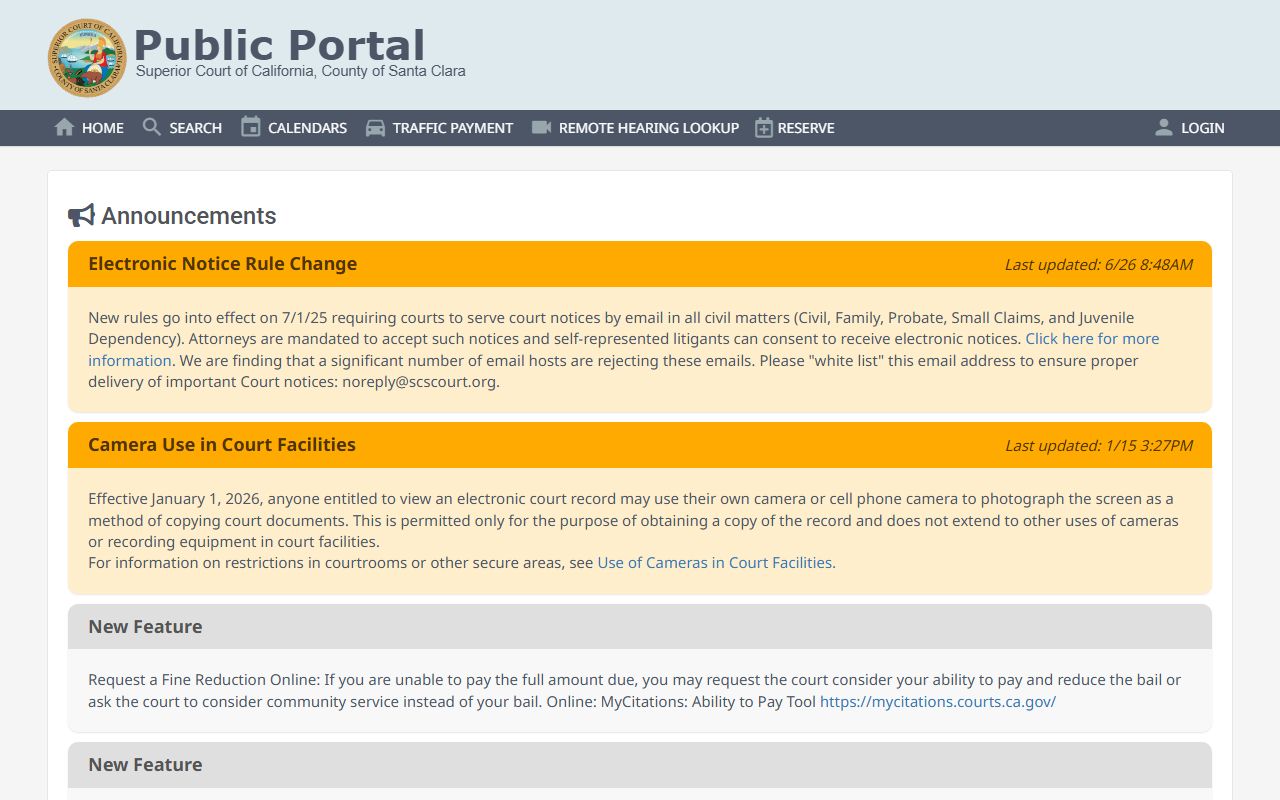
The online portal at portal.scscourt.org/search lets you search by party name, case number, or attorney name. Enter the last name of one spouse and the system will show all matching cases. You can filter by case type to see only family law cases. Each result shows the case number, filing date, and current status. Click on a case to see more details including the register of actions.
The register of actions is a list of every filing in the case. It shows the date each document was filed and the type of document. You can see when the petition was filed, when the response came in, when hearings were held, and when the judgment was entered. This gives you a timeline of the case. The portal does not show the actual documents, but it tells you what is in the file.
To get copies of documents, contact the court clerk. You can email familylaw@scscourt.org with your request. Include the case number if you have it, the names of both parties, and what documents you need. The clerk will respond with instructions on how to pay and when to expect your documents. You can also mail a written request or visit a courthouse in person.
Requesting Certified Copies
A certified copy of a divorce decree costs $15 in Santa Clara County. This is the standard fee under California law. The fee includes the certificate and all pages of the judgment. If you need other documents from the case file, those cost $40 for certification plus $0.50 per page for copies. Search fees are $15 if the clerk has to spend more than 10 minutes looking for the case.
You can request copies three ways. Email your request to familylaw@scscourt.org. Mail a written request to the courthouse. Or visit in person during business hours. Email is often fastest because the request goes directly to the records staff. Mail takes longer because it has to be sorted and routed to the right department. In-person requests can be done quickly if the file is on site.
For mail requests, send your letter to Santa Clara County Superior Court and include the case number or party names, your contact information, and what you need. The court will send you a bill or payment instructions. Once you pay, they will process your request and mail the documents to you. Processing times vary but most requests are completed within a few weeks.
Divorce Filing in Sunnyvale
To file for divorce in Sunnyvale, you or your spouse must have lived in California for at least six months and in Santa Clara County for at least three months. These residency requirements are set by California law. Once you meet them, you can file a petition for dissolution of marriage.
California uses no-fault divorce. You do not have to prove that anyone did anything wrong. The legal grounds are irreconcilable differences or incurable insanity. Most people file on the grounds of irreconcilable differences. You file the petition and summons, serve your spouse with the papers, and wait for a response. Your spouse has 30 days to respond. After that, you exchange financial information and try to reach a settlement.
California has a mandatory six-month waiting period before a divorce can be finalized. The waiting period starts when your spouse is served with the petition. Even if you agree on everything, the court cannot enter the final judgment until six months have passed. Once the waiting period is over and all issues are resolved, the judge signs the judgment. The divorce is then final. You can request a certified copy of the divorce decree from the court clerk.
What Records Are Available
A divorce case file includes many documents. The petition starts the case and lists what the person filing wants. The response is what the other spouse files. Financial disclosures show income, expenses, assets, and debts. Settlement agreements outline how the parties will divide property and handle custody. The final judgment is the court order that ends the marriage and makes everything official.
Not all documents in a divorce file are public. California law protects certain information. Child custody evaluations are often confidential. Some financial records may be sealed. Domestic violence restraining orders have special access rules. When you request records, the court provides what is available under the law. The divorce decree itself is public and anyone can get a copy. Other documents may have restrictions.
Using the Online Portal
The Santa Clara County portal is free to use. You do not need to create an account. Just go to portal.scscourt.org/search and select your search type. Party name search is most common. Enter the last name in the required field. You can add a first name to narrow results. The system searches all case types by default, so you might see criminal or civil cases along with family law. Use the case type filter to show only dissolution cases.
If you know the case number, use the case number search. This is faster and more accurate. Case numbers in Santa Clara County start with letters followed by numbers. Type in the full case number and hit search. The system will pull up that specific case right away.
The case details page shows information about the parties, the filing date, the case status, and the register of actions. The register of actions is a chronological list of filings. Each entry has a date, a document type, and sometimes a brief description. You can see when the petition was filed, when hearings were held, and when the judgment was entered. This timeline helps you understand what happened in the case. Note that you cannot download documents from this page. You must request copies separately.
Information Needed for Search
To find a divorce record from Sunnyvale, you need at least one spouse's name. The case number is even better if you have it. Here is what helps:
- Full first and last name of one spouse
- Case number if available
- Approximate year of divorce
- Date of marriage if known
Common names can return many results. If you search for a name like John Lee, you might get dozens of cases. Adding the year narrows it down. If you know the divorce was filed in 2016, filter your search to that year. The system will show only cases filed in 2016 with that name. If you have the case number, you do not need anything else. The case number will pull up the exact case.
Recent Legal Changes
Starting January 1, 2026, California law allows people to photograph court records at the courthouse. This change came from Assembly Bill 1524. Before this law, you could only get copies from the clerk. Now you can bring a phone or camera and take pictures of documents while you review them. This can save money on copy fees if you need a lot of documents.
Check with the clerk about the rules for photographing records. Some restrictions may still apply to certain types of documents. Sealed or confidential records likely cannot be photographed. But for public records, you now have the option to take your own photos instead of paying for copies. This is a big change that can help people who are doing research or who need many pages of documents.
Fees and Payment
Santa Clara County follows the standard fee schedule set by California law. Certified copies of divorce decrees cost $15. This includes the certificate and any pages that are part of the judgment. Copies of other documents are $0.50 per page. If you want them certified, add $40. Search fees are $15 if the clerk has to spend more than 10 minutes looking for the case.
The court accepts checks, money orders, and credit cards. Make checks payable to Santa Clara County Superior Court. If you mail a request, include payment with your letter. If the court cannot find the record, they will return your payment. Do not send cash through the mail. For in-person requests, you can pay with cash, check, or card at the courthouse.
Privacy and Access Rules
Anyone can request a copy of a divorce decree. You do not need to be a party to the case. The decree is a public record. Other documents may have restrictions. If you are not a party and you want something beyond the basic decree, check with the court clerk about whether that document is available to the public.
If you are a party to the divorce case, you have access to most of the file. You can get copies of documents you filed and most of what the other party filed. Some things may still be sealed even for parties. If you need a sealed document, you may have to get a court order to access it. The clerk can tell you what is available when you make your request.
Contact the Court
For questions about divorce records in Sunnyvale, email familylaw@scscourt.org. You can also call the court during business hours. The main number connects you to different departments. Ask for family law records or the clerk's office. Court staff can tell you how to request copies, what fees apply, and how long it will take.
The court website is scscourt.org. The website has forms, instructions, and links to the online portal. You can find information about filing fees, court rules, and where to get help with your case. The website also lists legal aid organizations that offer free assistance to people who qualify based on income. Court staff cannot give legal advice but they can explain the records process.