
Los Angeles Divorce Records
Los Angeles divorce records are maintained by Los Angeles County Superior Court. The city itself does not keep family law files. All dissolution cases for Los Angeles residents get filed with the county court system. The main family law courthouse is the Stanley Mosk Courthouse at 111 North Hill Street in downtown Los Angeles. This is the central hub for family law matters in the county. Los Angeles County is the largest court system in the United States, serving over ten million people. The court handles thousands of divorce cases each year. Every divorce file stays in the court system from start to finish. The clerk maintains these records permanently unless a judge orders them sealed for privacy reasons.
Los Angeles County Family Law Courts
The Stanley Mosk Courthouse is the primary family law facility for Los Angeles County. The building is at 111 North Hill Street in downtown Los Angeles. The Family Law Clerk's Office is in Room 426 on the 4th floor. You can reach them at (213) 633-6363. For new divorce filings, call (213) 830-0830. The Family Law Files office is in Room 112 on the 1st floor. This office handles requests for copies of divorce records. Call (213) 830-0803. The courthouse is open from 8:00 a.m. to 4:30 p.m. on weekdays.
Los Angeles County has ten district courthouses that can handle family law filings. These include locations in Pasadena, Burbank, Norwalk, Lancaster, Pomona, Van Nuys, Torrance, Santa Monica, Compton, and San Fernando. Each location can file new cases and provide some services. However, for copies of older records or specialized services, you may need to visit the Stanley Mosk Courthouse or the Archives and Records Center.

The Archives and Records Center is at 222 North Hill Street, Room 212 in downtown Los Angeles. This office stores older case files that are not kept at the main courthouse. The phone number is (213) 830-0803. Hours are 8:30 a.m. to 4:10 p.m. Monday through Friday. The Certification Unit is in Room 112C at 111 North Hill Street. They handle requests for certified copies of divorce decrees and other documents. In-person copy fees are $0.50 per page. Certification costs $25.00 per document.
Search Divorce Cases Online
Los Angeles County offers multiple online portals for searching court records. The dedicated divorce judgment search portal is at lacourt.org/ldosv2. This system lets you search specifically for dissolution judgments. You can look up cases by party name or case number. The portal shows basic case information and allows you to purchase copies of documents online. There are fees for name searches and document downloads.
Guest users pay $4.75 per name search. If you register for an account, the first ten searches cost $1.00 each. After that, the price goes back to the higher rate. Document downloads cost $1.00 per page for the first five pages of a document. Additional pages cost $0.40 each. The maximum charge for a single document is $40.00. These fees apply only to online purchases. If you visit the courthouse in person, you pay different fees based on standard court copy rates.
The county also runs LA Court Connect at lacc.lacourt.org and the Public Access Online Services portal at lacourt.org/paos. These systems cover family law cases from 1983 to the present. Document images are available starting May 1, 2000. Older cases show basic information but no document images. The online portals are helpful for finding case numbers and checking the status of a case. For full file review or certified copies, you must visit the courthouse or submit a mail request.
How to Get Divorce Records
If you know the case number, getting copies is easy. Visit the Family Law Files office at Room 112 in the Stanley Mosk Courthouse. Give the clerk the case number and tell them which documents you need. They will pull the file and make copies for you. Pay the fee when you pick up the copies. Same-day service is often available if the file is on-site. Certified copies include an official seal and signature from the clerk. These are required for legal purposes like remarriage or changing your name on government documents.
You can also request copies by mail. Write a letter that includes the case number, the names of both spouses, and a description of the documents you want. Include your mailing address and phone number. Send a check or money order for the estimated fees. Mail everything to Los Angeles Superior Court, Family Law Files, 111 North Hill Street, Room 112, Los Angeles, CA 90012. Processing time varies depending on how busy the court is and whether the file is on-site or archived. Most mail requests take two to four weeks.

When you do not have a case number, you need to ask the clerk to search. Provide the full names of both parties and any other details you know, like the year the divorce was filed or the approximate filing date. The clerk will search the database and let you know if they find a match. If they find multiple cases with the same names, they will give you a list so you can identify the correct one. Common names can produce many results, so additional information helps narrow the search.
California Divorce Laws
To file for divorce in California, you must live in the state for at least six months. You also need to live in the county where you file for three months. These residency requirements are set in California Family Code Section 2320. If you recently moved to Los Angeles or Los Angeles County, you must wait until you meet both time periods before you can file here.
California allows two grounds for divorce. The first is irreconcilable differences, which means the marriage is broken and cannot be fixed. The second is incurable insanity, which is almost never used. Most people file based on irreconcilable differences. California is a no-fault state, so you do not need to prove that your spouse did anything wrong. You just state that the marriage has irretrievably broken down. The legal grounds are listed in Family Code Section 2310.
After a judge signs the divorce judgment, there is a mandatory six-month waiting period before it becomes final. This waiting period starts from the date the respondent was served with the divorce papers or the date they appeared in court. The rule is in Family Code Section 2339. Once the waiting period ends, both parties are legally single and can remarry. The judgment resolves all issues including property division, spousal support, child custody, and child support.
Divorce Forms and Fees
All California counties use the same divorce forms. These forms are created by the Judicial Council and are available for free. The Petition to start a divorce is form FL-100. The Summons is FL-110. The Response is FL-120. The final Judgment is FL-180. In 2026, California introduced a new Joint Petition form, FL-700, for couples who agree on all terms. You can download all forms at selfhelp.courts.ca.gov/divorce-forms. The site also has fill-in-the-blank versions and step-by-step instructions.
The filing fee to start a divorce in Los Angeles County is $435 to $450. This fee is paid when you file the Petition. If you cannot afford the fee, you can request a waiver. Form FW-001 is the fee waiver application. You fill it out and attach proof of your income and expenses. The court will review your finances and decide if you qualify. Fee waivers can cover the filing fee, service fees, and other court costs. Many low-income people get fee waivers approved.
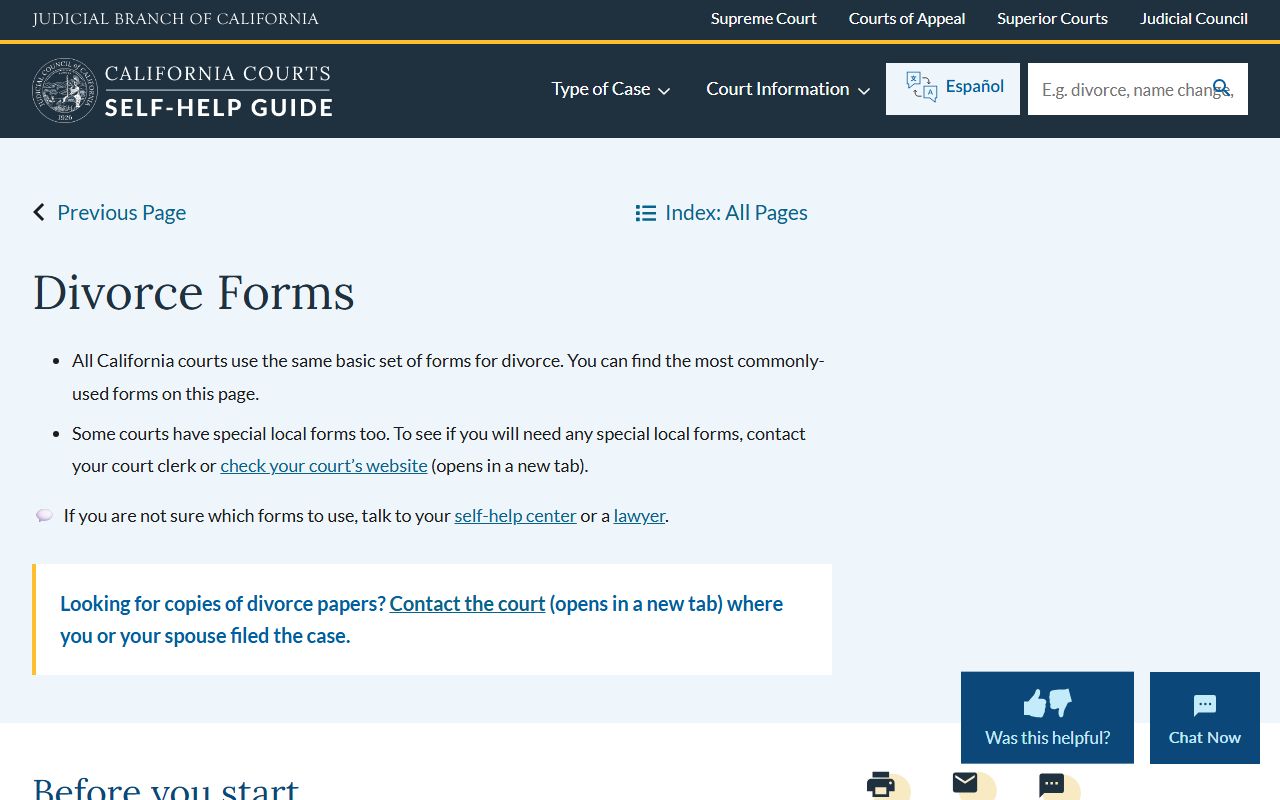
Los Angeles County offers free help through the Family Law Facilitator program. Facilitators work at the courthouse and assist people who are representing themselves. They cannot give legal advice or act as your lawyer, but they can explain forms and procedures. They will review your paperwork to make sure it is complete before you file. This service is free and available on a walk-in basis during court hours. There may be a wait depending on how many people need help that day.
Free Legal Help in Los Angeles
Legal Aid Foundation of Los Angeles provides free legal services to low-income residents of Los Angeles County. They handle family law cases such as divorce, custody, and domestic violence. Visit their website at lafla.org or call their main number to see if you qualify. They have income guidelines and prioritize cases involving children or abuse. Due to high demand, they may have a waitlist for new clients.
The Harriett Buhai Center for Family Law offers free services for family law matters. They focus on helping people with low incomes who are dealing with divorce, paternity, or custody issues. Contact them through their website at hbcfl.org or by phone. They provide advice, document preparation, and sometimes court representation. Because they serve the entire county, availability may be limited.
For general questions about California divorce law, the State Bar of California has public resources at calbar.ca.gov. The California Courts self-help website at selfhelp.courts.ca.gov has videos, guides, and FAQs for people without lawyers. Both sites are free to use and have information on every step of the divorce process. These resources can help you understand your options and decide whether to hire an attorney.