
Fullerton Divorce Records
Fullerton residents file all divorce cases with the Orange County Superior Court system. The city does not keep divorce records. All dissolution paperwork goes to county court facilities. You can start a case at any Orange County courthouse, but most divorce filings for Fullerton happen at the Lamoreaux Justice Center in Orange or the Central Justice Center in Santa Ana. Both locations handle family law matters for all Orange County cities. The court clerk maintains each case file from start to finish. Once a judge signs the final divorce decree, that document stays in the court file forever. Anyone can ask for copies of divorce records unless the case is sealed by court order.
Where to File in Orange County
The main hub for family law in Orange County is the Lamoreaux Justice Center. This courthouse sits at 341 The City Drive South in Orange. The Family Law Division operates on the 7th floor. You can reach them at (657) 622-6457. Their hours are 8:00 a.m. to noon, then 1:00 p.m. to 4:00 p.m. on weekdays. If you need to file a new divorce case or respond to one, you go to this building. The court also has self-help staff and family law facilitators who can answer basic questions about forms and procedures.
The Central Justice Center in Santa Ana also handles divorce cases. That building is at 700 Civic Center Drive West in Santa Ana. You can call them at (657) 622-6878. For older cases filed before 1968, there is a Records Management office on the 1st floor of this courthouse. If your divorce happened decades ago, the file might be stored in this archive area. Historical records in Orange County go back to 1889. Staff can help you find and request copies of old divorce files.

Orange County has specific fees for divorce records. A certified copy of a divorce decree costs $15.00. This fee includes all the pages in the judgment. Most other certified documents cost $40.00 plus $0.50 per page for copies. If you need the clerk to search for a case and you do not have a case number, the search fee is $15.00. Regular copies without certification are $0.50 per page. You can pay by cash, check, or money order at the courthouse. Some services accept credit cards but may charge a processing fee.
Search Divorce Cases Online
Orange County runs a public online portal for family law cases. You can access it at fampub.occourts.org. This system lets you search by party name or case number. Type in the last name and first name of one spouse to see a list of matching cases. The portal shows basic case info like the filing date, case type, and current status. It does not show full document images for most family law records due to privacy rules.
The online system covers cases from 1990 and later. Dissolution cases filed after 1997 are more likely to have detailed information in the portal. If you are looking for a divorce from the 1980s or earlier, you need to contact the Records Management office directly. They can search paper files and microfiche records. The online portal is free to use. You do not need to create an account or pay to search. However, if you want certified copies of documents, you must request those through the clerk's office.

Processing times for mail requests run about 30 to 45 days in Orange County. If you visit the courthouse in person, you can often get copies the same day or within a few days. Off-site files take longer because staff must retrieve them from storage. The court provides two forms to help with requests. Form L-0696 is for copy requests. Form L-0006 is for record searches when you do not have a case number. You can download these forms from the court website at occourts.org.
How to Get a Divorce Record
If you know the case number, getting a copy is simple. Write down the case number and the names of both parties. Go to the Lamoreaux Justice Center or mail your request to the court. Include a check or money order for the copy fees. The clerk will pull the file and make copies. If you need a certified copy, say so in your request. Certified copies have a raised seal and signature from the clerk. These are often required for legal purposes like remarriage or changing your name on government documents.
When you do not have a case number, you need to provide as much detail as possible. Give the full names of both spouses. Include the approximate year the divorce was filed. The more info you provide, the faster the search goes. Common names can produce many results, so adding a middle name or date of birth helps narrow it down. The clerk will search the database and let you know if they find a match. If no record exists under the names you provided, they will notify you.
Not all divorce records are open to the public. Some cases are sealed by court order. Sealed cases do not show up in public searches. Only people named in the case or their attorneys can access sealed records. Domestic violence cases sometimes have restricted access to protect victims. If you are a party to the case, you can request your own records even if they are sealed. Bring photo ID and proof that you are named in the case. The clerk will verify your identity before releasing any documents.
California Divorce Laws
California law sets clear rules for divorce. You must live in the state for at least six months before filing. You also need to live in the county where you file for at least three months. These residency rules are found in California Family Code Section 2320. If you just moved to Fullerton or California, you have to wait until you meet the residency requirement.
The state allows two grounds for divorce. Most people file based on irreconcilable differences. This means the marriage is broken and cannot be fixed. The other ground is incurable insanity, which is rarely used. California is a no-fault state, so you do not need to prove wrongdoing by your spouse. The legal grounds are listed in Family Code Section 2310.
After the court grants a divorce, there is a six-month waiting period before the judgment becomes final. This waiting period is set by Family Code Section 2339. Once the six months pass, both parties are legally single again. The final judgment includes decisions about property division, spousal support, child custody, and child support if applicable. The judgment is a permanent court record kept by the Orange County Superior Court.
Forms You Need
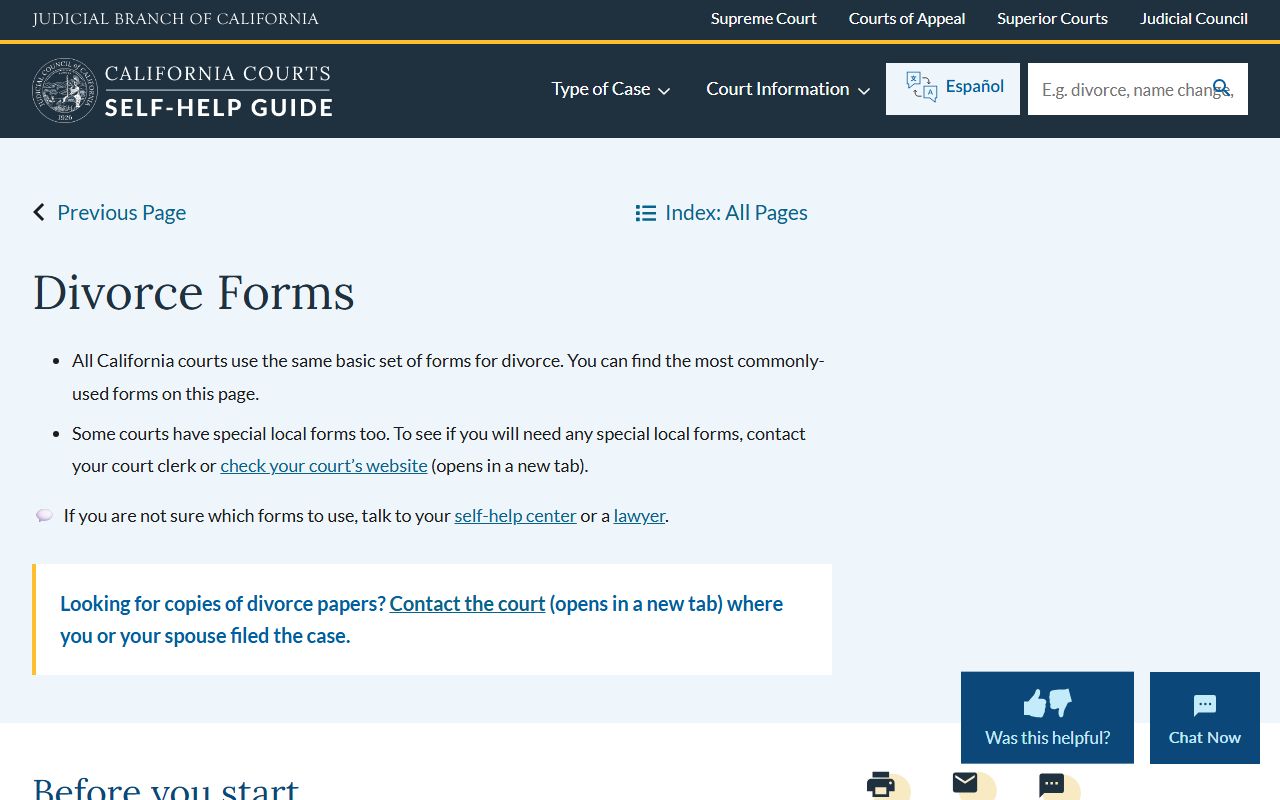
All California courts use the same basic divorce forms. These are created by the Judicial Council and are available for free. The main forms include the Petition (FL-100), Summons (FL-110), and Response (FL-120). If you and your spouse agree on everything, you might use the newer Joint Petition form (FL-700), which was introduced in 2026. The final Judgment form is FL-180. You can download all forms at selfhelp.courts.ca.gov/divorce-forms.
Filing a divorce in Orange County costs between $435 and $450. This is the initial filing fee you pay when you submit the Petition. If you cannot afford the fee, you can ask for a fee waiver. Fill out form FW-001 to request a waiver based on low income. The court will review your financial information and decide if you qualify. Fee waivers can cover the filing fee, service fees, and other court costs.
Orange County offers free help through the Family Law Facilitator program. These staff members work at the courthouse and assist people who do not have lawyers. They cannot give legal advice, but they can explain forms and procedures. They can also review your paperwork for completeness before you file. To reach the facilitator, call the court or visit during business hours. There is no charge for this service.
More Help for Fullerton Residents
The Public Law Center in Santa Ana provides free legal help to low-income residents of Orange County. They handle family law matters including divorce, custody, and support issues. You can reach them at (714) 541-1010 or visit publiclawcenter.org. They have intake hours and eligibility requirements based on income and household size.
Legal Aid Society of Orange County also offers free services to qualifying individuals. Their office is in Santa Ana and serves all of Orange County including Fullerton. They focus on family law, domestic violence, and elder law. Call (714) 571-5200 for information on how to apply for their services. Both organizations may have waitlists due to high demand.
For general questions about California divorce law, the State Bar of California has a public resource page. Visit calbar.ca.gov to find articles and FAQs about family law topics. The California Courts self-help website at selfhelp.courts.ca.gov has videos, guides, and step-by-step instructions for people representing themselves in court. These resources are free and available to everyone.